
Tracking PPV Spend Across Several Free Pages Monthly
OnlyFans free pages charge nothing to follow, yet several together can still produce a real monthly bill through pay-per-view unlocks. Tracking that spend means logging every PPV message you open, grouping it by page, and comparing the running total against your statement. A free subscription removes the base price, not the ability to spend, and the pages covered by BestOnlyFans ranking guides show how easily small unlocks add up. BestOnlyFans refreshes its rankings every month.
The core problem is structural: a $0 follow feels costless, so the spending decision moves entirely to the moment a locked message arrives. Within weeks, most subscribers cannot name which page took the largest share of their money. The ranking method behind these guides stays consistent across updates. The BestOnlyFans method stays consistent across updates.

Why Multiple Free Pages Produce Real Costs
A free page sets its subscription price to $0 and earns through pay-per-view messages, tips, and paid chat instead. Each unlock carries its own price, and PPV messages commonly unlock for up to $50. Nothing about the $0 label limits what a single message can request.

Multiply that across several pages and the shape of the bill changes. Five pages with two $8 unlocks each per month is already $80. Ten pages with the same pattern reaches $160, and none of that ever appears as a subscription line.

| Cost Type | Typical Range | Frequency |
|---|---|---|
| PPV message unlock | Up to $50 per unlock | Several times per week on active pages |
| Paid chat | $3-$5 per message | Per conversation, often bundled in sessions |
| Tips | Up to $100 | Occasional, tied to requests |
| Base subscription | $0 on free pages | Monthly, non-billing |
Two mechanics matter for tracking. The platform takes a 20% fee on everything, so creators keep 80% of each unlock, which is why PPV pricing on free pages often runs higher than subscribers expect. Second, a card verification hold of $0.10 may appear when you add a payment method; it is refunded within days and is not spending.
Building a Simple Monthly Tracking Sheet
You do not need software. A notes app, a spreadsheet, or a paper page works, as long as every unlock is logged within a minute of happening.

Keep one row per unlock and one running total per page. The columns below cover everything the method needs, and adding more fields usually means the log stops getting updated.
- Date — the day the unlock happened, so weekly patterns become visible.
- Page name — the exact handle, not a nickname, so it matches your statement later.
- Unlock cost — the amount charged, with paid chat messages logged individually.
- Running total — spend for that page so far in the current month.
- Notes — what the unlock was and whether it felt worth the price.
After a month, a row reading “video unlock, $18” tells you nothing about value. A row reading “video unlock, $18, watched once, underwhelming” tells you whether that page deserves a place next month.
Categorizing Spend by Page and Content Type
Once the log exists, group it two ways: by page and by content type.
- Photo sets — usually the lowest unlock prices, and the category most likely to accumulate unnoticed.
- Video unlocks — higher individual prices, fewer per month, easier to remember.
- Paid chat — $3-$5 per message, the category that grows fastest inside one session.
- Tips — up to $100 each, rare but heavy enough to distort a monthly total.
Most subscribers find one category dominating, and it is rarely the one they guessed. People who assumed video unlocks were the problem often discover photo sets across nine pages cost more in aggregate.
Page-by-page pricing comparisons at onlyfans free brazil rank pages on pricing transparency and content volume rather than follower counts. That framing applies to your own log: a page with modest unlocks that consistently delivers beats a cheap page you never revisit.
Setting Per-Page Caps Before You Follow
A cap is a monthly spending limit assigned to a single free page before you subscribe. It converts an open-ended decision into a fixed one and removes the need to judge each unlock on the spot.
- Estimate typical PPV cost. Check the page’s recent post frequency and price points, using the $4.99 to $49.99 platform range as the outer boundary.
- Set a monthly limit. Assign an amount you would accept losing without noticing, commonly $10-$25 per page.
- Note the cap beside the page. Write it in the tracking sheet so the limit stays visible during the month.
- Review weekly. Check the running total against the cap every seven days rather than waiting for month end.
When the cap is reached, pause unlocks on that page for the rest of the month. The page stays followed, the subscription stays free, and the limit holds. Most pages send PPV messages whether you open them or not, so no action is needed beyond not unlocking.
Recognizing Budget Creep Across Free Pages
Budget creep on free pages rarely looks like a decision. It looks like a slow change in routine, spread across weeks, with no single moment that feels like overspending.
- More pages followed — the roster grows by one or two each month without any removals.
- More unlocks per week — the same pages get unlocked more often than last month.
- Rising monthly total — the running total exceeds the previous month without a matching change in usage.
The subtler signs matter more. Opening locked messages without checking the price first, unlocking during late-night sessions, and skipping the weekly review are the behaviors that precede almost every surprise bill.
Tip: log the unlock before the content finishes downloading. If you log afterward, you will skip it roughly half the time, and the missing rows are exactly the ones that matter at month end.
If a page raises its price, auto-renew stops and existing access lasts until the paid period ends. On a free page this rarely applies, but the principle guides caps: when a page changes its pricing behavior, treat it as a new decision and reassess the limit.
Reconciling Totals at Month End
Reconciliation turns a log into a budget. Compare what you recorded per page against what the billing statement shows, and investigate any gap larger than a few dollars.
| Page | Logged PPV Spend | Statement Total |
|---|---|---|
| Page A | $0 (capped at limit) | $0 |
| Page B | $14 (4 unlocks) | $14 |
| Page C | $31 (2 unlocks, 1 chat session) | $31 |
| Page D | $9 (3 unlocks) | $9 |
Paid chat sessions logged as one entry may miss individual messages. A tip may not appear in the log at all because it felt separate from PPV. Verification holds of $0.10 may show up and later reverse, and they should be excluded from totals.
Any unfamiliar charge deserves a closer look rather than a shrug. Readers who understand how payment fraud works catch unauthorized activity faster because they know what legitimate billing looks like.
Adjusting Your Free Page Roster
The roster is the most powerful variable. Every page you unfollow removes an entire category of potential spending, and the decision can be made from the log rather than from memory.
Rank pages by cost per useful unlock. A page where half the unlocks produced content you would pay for again earns its cap. A page where notes read “underwhelming” three months running does not, regardless of price.

Removing a free page takes seconds and costs nothing, which makes roster adjustment the cheapest correction available. Keep three to five pages that consistently earn their caps, and treat every addition afterward as a decision requiring a cap.
Tools and Habits That Make Tracking Easier
Tools are secondary to habits. A spreadsheet nobody updates performs worse than a notes file updated within a minute of every unlock. Set the system up once, then let routine carry it.
- Log after each unlock. One row, under a minute, before moving on to anything else.
- Review weekly. Compare each page’s running total to its cap every seven days.
- Reconcile monthly. Match the log against the statement and investigate every gap.
- Adjust caps. Raise, lower, or remove based on what the month actually showed.
Calendar reminders handle the recurring parts: one weekly reminder for the review, one monthly reminder for reconciliation. Notes apps handle the log. Payment notifications, where available, give a second record to check the log against.
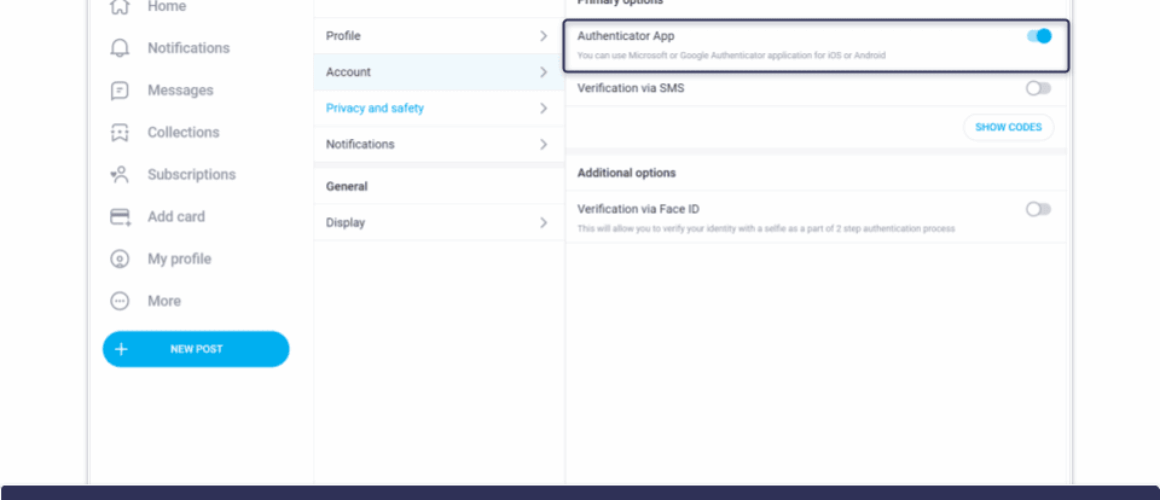
Turn on two-factor authentication in account settings, shown in the screen below, so the account cannot be opened without a second step. Then decide before opening any locked message whether it fits inside the month’s cap for that page.

A monthly total you can name beats a vague sense that free pages cost nothing. The method holds whether you follow three pages or thirty: log every unlock, cap each page, review weekly, reconcile monthly, and remove what does not earn its place.
FAQ
How do I track PPV spending across several free pages?
Keep one running log with the date, page name, unlock cost, running total, and a short note for each unlock. Add a monthly cap per page before you follow it, review totals weekly, and at month end compare the log against your billing statement.
What is a realistic monthly PPV total for multiple free pages?
It depends on how many pages you follow and how often you unlock. A modest setup of three to five pages with a few unlocks each commonly lands in the $20-$80 range, while ten or more active pages can exceed that. Paid chat and rare tips can push a total well above the unlocks alone.
Should I set a spending cap per free page?
Yes. A cap converts an open-ended decision into a fixed one and removes the need to judge each unlock in the moment. Assign a monthly limit you would accept losing without noticing, note it beside the page, and pause unlocks on that page once the cap is reached.
How often should I reconcile PPV spending with statements?
Once a month at minimum, and ideally alongside a weekly review of running totals. Monthly reconciliation catches missed log entries and unfamiliar charges while the details are still fresh. If a page’s total and the statement disagree, check paid chat sessions and verification holds before assuming an error.